

What the Verizon Outage and Recent Brand Failures Teach Us About Crisis Leadership

Over the past year, a growing list of well-known brands — including Saks Global, Rite Aid, Forever 21, and Marriott — have found themselves in the headlines for bankruptcy filings, operational breakdowns, or reputational backlash. While each situation looks different on the surface, they all point to the same underlying issue: crisis leadership failures that began long before the crisis became public – a dimmer switch versus the flick of a light switch. A timely example came up last week with the Verizon wireless outage, which disrupted calling, texting, and mobile data for customers across large parts of the U.S. Phones were pushed into “SOS” mode, and for hours, millions of people were left without reliable connectivity. While Verizon worked to restore service and later offered account credits, early communication was limited, forcing customers to rely on social media and outage trackers for answers. The outage itself was disruptive — but the leadership response shaped how customers perceived the event. It felt as if many were wondering this this was a technical issue or widespread cyber-attack. This highlights a critical distinction leaders often overlook: the difference between sudden crises and smoldering ones. Research consistently shows that roughly 70–75% of corporate crises are “smoldering” issues — problems leaders were aware of, or should have been aware of, but failed to address quickly enough. These slow-burn issues don’t grab attention at first, which makes them easier to ignore — until they explode into full-scale crises. The Verizon outage may feel sudden to customers, but system vulnerabilities, redundancy planning, and response protocols are all smoldering issues (or opportunities) that require leadership attention long before something breaks. The same pattern appears in recent bankruptcies. Saks Global’s collapse followed years of mounting debt and delayed decisions. Rite Aid’s repeated financial struggles reflect unresolved operational and legal pressures. Forever 21’s decline was driven by leadership waiting too long to adapt to shifting consumer behavior. Across industries, the lesson is clear: crises are rarely caused by a single bad day. They are the result of hesitation, overconfidence, and delayed action. Leaders often move quickly when faced with dramatic, visible emergencies — but move far too slowly when the warning signs are quieter. In Fallston Group’s experience, there are often many reasons for this, including the fact that hard decisions often lead to investor backlash, stock price hits, and layoffs. Not to mention an overreliance on brand longevity and perceived marketplace power. Strong crisis leadership isn’t about perfection. It’s about early recognition, transparent communication, and decisive action. Customers, employees, and stakeholders can tolerate disruption. What they won’t tolerate is silence, confusion, or the sense that leaders failed to act when they had the chance. Again, ‘If you don’t tell your story, someone else will.’ However, our mantra taken one step further, ‘If you don’t take action, someone else will.’ In today’s environment, where a single outage or headline can redefine a brand overnight, crisis leadership is no longer optional — it’s a core responsibility of anyone in charge.
Protecting the Integrity of the Game: Enforcement, Prevention & Treatment
The integrity of competition is non-negotiable. The recent NBA betting scandal reminds us that when insider information, game manipulation, and gambling converge, trust in the sport collapses. Once that trust erodes, so does the credibility of the league, the athletes, and the fan experience itself. At Fallston Group, we see this not just as a sports issue, but as an institutional one. Gambling risks extend far beyond individuals placing bets — they test the resilience of entire organizations. That’s why leadership must own both prevention and response. The system must be designed to detect, investigate, and enforce consequences swiftly and transparently. Prevention begins with culture. Policies on paper mean little without education, accountability, and awareness. Every player, coach, and staff member should understand how gambling risk manifests — from subtle conversations about injuries to outright solicitation for insider information. Building an integrity-first mindset takes ongoing training, honest dialogue, and leadership that models ethical behavior daily. Treatment — in this context — isn’t just about punishment. It’s about rehabilitation, support, and restoring faith in the system. When missteps occur, the goal must be to rebuild both the individual and the institution’s credibility. The legalization and normalization of sports betting mean that organizations must adapt faster than ever. Proactive risk management, clear communication, and unwavering enforcement aren’t optional — they’re essential. Ultimately, fairness, transparency, and legitimacy are the lifeblood of competition. Fans deserve to know the game they love isn’t compromised. As I shared on FOX 45 Baltimore, it’s our collective responsibility to protect that integrity — through strong enforcement, thoughtful prevention, and meaningful treatment. Because without integrity, there is no game.
Rob Weinhold, CEO of Fallston Group, Shares Insight on FOX Following AWS Global Outage
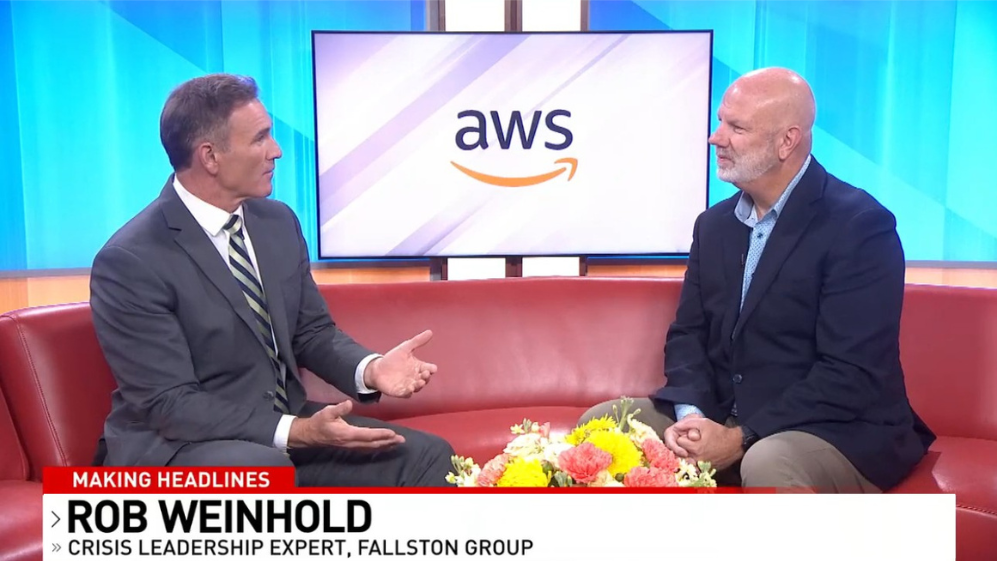
Watch interview on Fox: https://foxbaltimore.com/fox45-mornings/amazon-web-services-outage-causes-global-disruption-highlights-economic-reliance#
When the Cloud Breaks: Leadership Lessons from the AWS Outage
When the Cloud Breaks: Leadership Lessons from the AWS Outage During the early hours of October 20th, a major outage at Amazon Web Services (AWS) took hundreds of platforms offline and caused chaos for thousands of companies. Global brands like Snapchat, Venmo, Fortnite, Signal, and Ring were severely affected, along with UK institutions such as Lloyds Bank and HM Revenue & Customs. When the cloud goes down, the ripple effect hit with velocity and impact, and no organization is immune. Whether you are a global enterprise or a main street business, when your business continuity is disrupted, it can cost you time, money, customers, and careers. Moments like these separate reactive organizations from resilient ones. That’s why Fallston Group teaches the Resilient Moment Communications Model — a practical framework that guides leaders through the uncertainty of crisis. This model, developed by Dr. George Everly, provides a strategic communications path for leaders of every organizational shape and size. The Model suggests that if a leader answers the following five questions, at any stage of crisis, most questions that people have about an issue will have been answered: What happened? Be factual and transparent. AWS’s disruption apparently stemmed from an internal subsystem failure — not a cyber-attack. Clear early messaging prevents speculation from taking root. What caused it? Explain the root cause in plain language. Jargon confuses; clarity builds confidence. What are the effects? Acknowledge the human and business impact. From customer frustration to investor concern, empathy and accountability sustain trust. What is being done about it? Demonstrate decisive action. Communicate progress and solutions without over-promising. Precision and presence matter. What needs to be done in the future? Show learning and leadership. Strengthen systems, train teams, and rehearse responses before the next test. The AWS outage is a real-time reminder that resiliency is not just technical — it is organizational. As we say at Fallston Group, ‘you don’t spin your way through crisis; you lead your way through.’ Fallston Group helps leaders prepare for, navigate through, and recover from issues of sensitivity, adversity, and crisis — because reputation leads to trust, and trust leads to valuation. For more information, link to www.fallstongroup.com. – Rob Weinhold, Chief Executive of Fallston Group
Crisis Leadership: The Hidden Catalyst for Growth
It may seem counterintuitive, but crisis is not the enemy of progress—it’s often the spark that fuels it. In a world driven by relentless competition, digital disruption, and changing consumer expectations, crisis is not only inevitable—it’s essential. The real question leaders must ask is not if crisis will strike, but when. And more importantly: are you ready to meet the moment? Well-built organizations don’t just endure crisis—they invite it. They understand that when disruption hits, it reveals character, clarity, and competitive advantage. According to PwC’s 2023 Global Crisis Survey, 96% of organizations experienced at least one crisis in the past two years. Yet nearly 70% of those who were well-prepared emerged stronger. Crisis whittles down the marketplace—removing the fragile and reaffirming the future-ready. Darwinism is alive and well in today’s digitized world. Organizations either adapt—or disappear. But readiness doesn’t happen by accident. Leaders must treat crisis readiness as a core strategic investment—not an afterthought. This begins with a comprehensive reputational risk assessment to identify the threats that could compromise your brand, operations, and long-term viability. From there, organizations must build customized crisis plans—not templated checklists, but living, breathing playbooks that reflect your values, people, and culture. And most critically: you must train – how you practice is how you will play under duress. You must pressure test these plans under simulated, real-world conditions. Just like elite athletes or military teams, crisis-ready organizations drill until muscle memory kicks in. Because when the pressure is on, you don’t rise to the occasion—you fall to the level of your training. Fallston Group helps you achieve the organizational memory needed to turn short-term adversity into long-term advantage. Not being prepared in this day and age is utterly unacceptable as anyone with an internet connection and recording device can wreak havoc on your brand. Crisis is not a pitfall. It’s a proving ground. A growth strategy in disguise. The question is not whether crisis will find you—it’s whether you’ll be ready to lead when it does. Those who plan, train, and act decisively don’t just survive—they set the new standard for excellence. Remember, reputation leads to trust, and trust leads to valuation. And not all currency is financial. Invest in your readiness now to ultimately preserve your time, money, consumer confidence and career. Your reputation and your future depends on it.
Honored and Rooted: Fallston Group Recognized Among Greater Baltimore’s Top Family-Owned Businesses

Fallston Group is grateful to announce that the Baltimore Business Journal has recognized us as one of Greater Baltimore’s top family-owned businesses for 2025! This honor, part of the BBJ’s annual Family-Owned Business Awards, celebrates companies that have demonstrated excellence, innovation, ethics, and philanthropy—qualities we strive to embody every day. We are especially grateful to stand alongside other businesses that, like us, have put down deep roots in Maryland and built trust across generations. Fallston Group was founded with a simple but powerful mission: help people during life’s most critical times – it’s baked into our DNA. As a family-owned business, we approach our work with a personal sense of responsibility—not just to our clients, but to the community we call home. Our team’s commitment to reputation management and crisis leadership isn’t just about business but legacy, accountability, and impact. Our work is more relevant than ever in today’s rapidly changing world. Trust is fragile, and brand equity can be won or lost in a single moment. We’re here to safeguard our clients’ reputations and turn short-term adversity into long-term advantage with clarity, conviction, and care. Thank you to the Baltimore Business Journal for this meaningful recognition, and congratulations to our fellow honorees. We look forward to continuing to serve our clients, partners, and the Greater Baltimore community for years to come.
Protecting Trust During Turbulence: Crisis Leadership Lessons from the 23andMe Situation
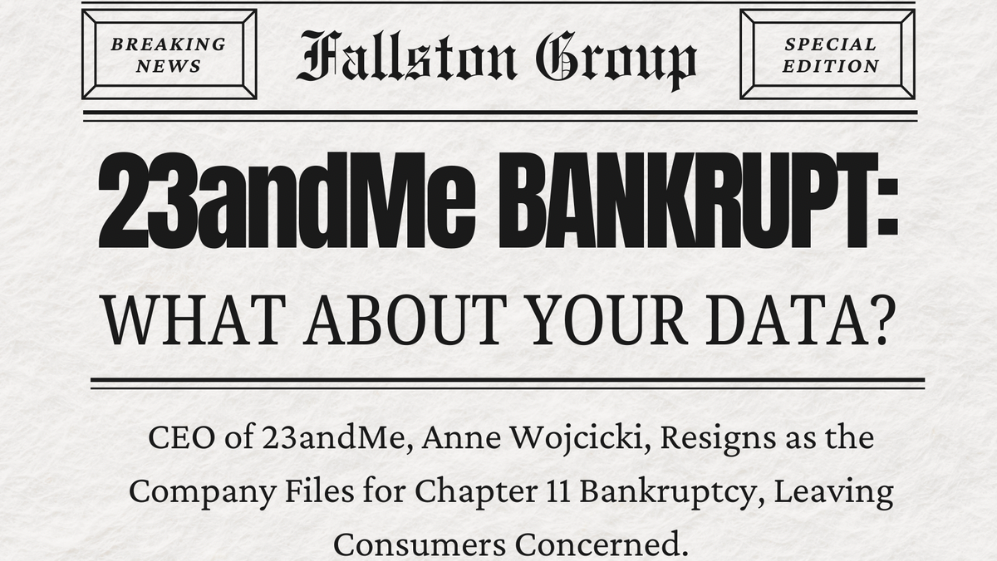
In today’s data-driven environment, few assets are more valuable—or more vulnerable—than trust. For companies entrusted with sensitive personal information, the stakes are high, especially when operational or financial uncertainty arises. The recent developments involving 23andMe serve as a critical case study in how companies must navigate crisis moments with transparency, ethical leadership, and a steadfast commitment to their stakeholders. 23andMe, known for its consumer DNA testing services, is facing a challenging chapter marked by a Chapter 11 bankruptcy filing and the unexpected resignation of its CEO. These events have understandably sparked public concern, particularly surrounding the future of the genetic data the company has collected over the years. While the company has stated that any prospective buyer must honor its existing privacy policy and comply with relevant laws, this assurance has done little to ease the minds of many customers who are unsure of what the future holds for their personal information. Although Fallston Group makes no assumptions about the internal decisions or motives of 23andMe’s leadership, the situation highlights important crisis leadership principles that all organizations—especially those managing sensitive consumer data—should consider. When customer trust is at risk, how an organization responds can either reinforce its credibility or accelerate reputational decline. The following best practices offer strategic guidance for companies in similarly high-stakes situations. Crisis Leadership Best Practices for Data-Centric Companies 1. Communicate early, clearly, and consistently When news breaks—whether through official channels or speculation—organizations must respond quickly and clearly. Proactive communication from leadership not only helps control the narrative but also reinforces that the company is engaged, responsive, and accountable. Silence or ambiguity, particularly in moments of uncertainty, can be deeply damaging to public trust. 2. Empower customer control If consumers are anxious about the future of their data, it’s critical to offer accessible and immediate options to manage, delete, or opt out. Even during complex proceedings such as bankruptcy or M&A, providing clarity around data usage and ownership demonstrates respect for customer autonomy and helps preserve long-term credibility. 3. Reaffirm original commitments—or transparently explain changes Trust is built on consistency. If a company has made commitments about data privacy in the past, reaffirming those promises publicly can provide reassurance. If changes are necessary due to evolving business circumstances, transparency is key. Clear rationale and respectful communication are essential to mitigating backlash. 4. Establish third-party oversight Independent ethics panels or data governance boards can provide unbiased oversight and bolster stakeholder confidence. Particularly during transitions of ownership or leadership, involving a credible third party adds an extra layer of accountability. 5. Prioritize people over process In crisis moments, process alone is not enough. Companies must lead with empathy and a people-first mindset, recognizing that behind every data point is a person who placed their trust in the organization. 23andMe is not the first company to face this type of reputational pressure, and it will not be the last. In fact, as more businesses collect and store personal data—whether in healthcare, finance, retail, or technology—these moments of reckoning will only increase in frequency and intensity. The lesson for all organizations is clear: ethical leadership, open communication, and values-driven decision-making are not optional—they are foundational. Companies that embrace these principles not only weather the storm, but often emerge stronger and more respected in the eyes of their stakeholders. At Fallston Group, we help leaders navigate critical moments of adversity by focusing on what matters most—reputation, trust, and the long game. Because in the end, those who lead with clarity and conviction are the ones who earn the right to lead again tomorrow. If your organization manages sensitive information and is facing—or preparing for—a high-stakes moment, now is the time to evaluate your crisis readiness. Fallston Group partners with leaders to protect reputation, preserve trust, and guide smart, strategic decisions when it matters most. Let’s talk about how we can support you.
University Presidents Must Lead with Strength During Campus Protests
In today’s charged geopolitical climate, university presidents must be prepared to manage campus protests with clarity, control, and confidence. Failure to do so can cost them their leadership post—and future job opportunities. We’ve seen this play out recently where higher education leaders were forced to step down after losing control of campus unrest. The message is clear: university presidents who fail to lead with strength and strategy risk being replaced. Leadership Begins Before the Crisis The best way to manage a protest is to prepare before it happens. Leaders must set clear expectations around free speech, protest locations, and acceptable conduct. It’s about striking a balance between allowing healthy expression and ensuring campus safety. Equally important is open communication with student leaders and faculty. I often tell my clients, “If you don’t take the time to listen before a crisis, don’t expect anyone to listen to you during one.” Building trust early can prevent protests from escalating into chaos as crises cost time, money, stakeholder trust, careers, and, in the worst of scenarios, freedom and lives. Engage local law enforcement early, they are part of the solution. Firm Boundaries No university can afford to let protests spiral out of control. That means holding people accountable when they cross the line. Harassment, bullying, and physical confrontations cannot be tolerated—period. Universities must also be extremely cautious about allowing outside agitators onto campus – many call these individuals professional protestors who often have ‘get out of jail’ strategies before being arrested. External groups generally hijack student movements, turning peaceful demonstrations into national spectacles that overwhelm leadership and damage institutional reputation while playing out on live television. Intriguing for viewership, terrible for the university. Lessons from Leadership Failures Recent history has shown what happens when presidents lose control: · Columbia University: President Minouche Shafik resigned after allowing protests to escalate, leading to mass arrests and media scrutiny. (Taheri, M. (2024, August 15). Full list of college presidents who have resigned amid campus protests. Newsweek. https://www.newsweek.com/full-list-college-presidents-who-have-resigned-amid-campus-protests-1939822) · Brandeis University: President Ronald Liebowitz stepped down following a no-confidence vote due to his mishandling of student demonstrations. (Saul, S. (2024, September 25). Brandeis president steps down amid budget issues and protests. The New York Times. https://www.nytimes.com/2024/09/25/us/brandeis-university-president-resigns.html) · Rutgers University: President Jonathan Holloway resigned as protests fueled a toxic campus environment he could no longer manage. (Rumpf-Whitten, S., & Fox News. (2024, September 18). Rutgers University president set to resign after contending with pandemic, anti-israel protests. Fox News. https://www.foxnews.com/us/rutgers-university-president-resign-contending-pandemic-anti-israel-protests?) Lead or Lose In crisis, decisive leadership isn’t optional—it’s essential. University presidents must set expectations, enforce boundaries, and maintain control. Otherwise, they will lose not only credibility but also their jobs. Leadership is about making tough calls and standing firm in the face of adversity—because when presidents lose control, everyone loses. Every member of the university community—students, faculty, and staff—deserves an environment that is both emotionally and physically safe. It is the responsibility of leadership to foster a culture where learning can thrive without fear, intimidation, or undue disruption. When working with leaders facing adversity, I often say, “I’ve never known a leader to look in the rear-view mirror and say ‘I’m sorry I made the right decision.’” The right decision starts today, before the campus protest.
Leadership in Crisis: Key Lessons from the Fatal Aircraft Accident at Ronald Reagan Washington National Airport
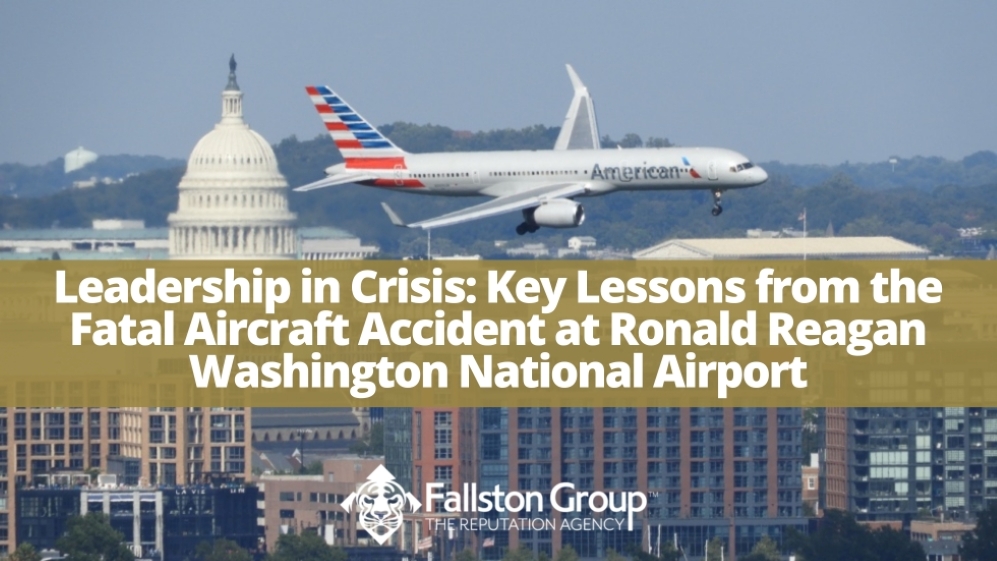
When crises emerge, leaders are tested in ways that define legacies. The January fatal mid-air collision at Ronald Reagan Washington National Airport (DCA) highlights the importance of swift crisis response, including transparent communication and next steps for the immediate and long-term future. There are three critical leadership considerations that emerge after such incidents. Crisis Response: The Balance Between Speed and Accuracy Immediate response is the top priority during a crisis or time of devastation. First and foremost, it involves a concerted effort to ensure the physical safety of those in the immediate area. Second, managing the coordination of communication between the stakeholders involved is critical. Each stakeholder involved has a different audience or message it needs to share. However, due to the sensitive nature of a tragic event and the regulations of the aviation industry, coordination of communication presents a two-fold challenge: Stakeholder leadership must be transparent with the public while being careful about what they say publicly to avoid inadvertently sharing misinformation and getting ahead of the investigations that will soon commence. In this case as with any aviation incident, the National Transportation Safety Board (NTSB) leads the investigation, and what is shared publicly and when, while other stakeholders, including the airline, follow suit. As discoveries are waiting to be validated, only factual information, such as initial details of the incident, such as aircraft type, flight number, and departure/destination information, can be disclosed to the public. While the public may demand immediate answers, leaders must prioritize fact-based updates over speculation. Ensuring the fidelity of the investigation is the bedrock of restoring trust and supporting the victims and people affected by the tragedy. Effective crisis leadership is distinguished by the delicate balance between speed and accuracy. When handled well, it prevents misinformation and ensures the integrity of the ongoing investigation. Transparent Communication Led with Empathy Builds Trust Silence in a crisis fuels speculation and erodes trust. Even though leaders might not initially be able to provide answers to the hard-hitting questions, there is still an opportunity to communicate clearly, consistently, and, most importantly, with empathy. This was demonstrated effectively by American Airlines’ leadership following the crash. Soon after the incident, American Airlines released a public statement acknowledging the tragedy. Within an hour, CEO Robert Isom followed the initial statement with a video briefing, openly stating that while many questions remain unanswered, he would share what he could. Acknowledging uncertainty while providing available facts is key. Nearly three weeks after the incident, American Airlines continues to post statements and responses to a dedicated part of its website to keep people informed throughout the investigation. This is essential to being perceived as transparent, which fosters confidence and accountability. Organizations that maintain this level of engagement—rather than going silent after the first wave of media coverage—while working cooperatively with the NTSB are the ones that ultimately have the highest probability of rebuilding trust and credibility in the aftermath of a crisis. Long-Term Recovery & Lessons Learned to Define Leadership Legacies Aviation disasters don’t just end with the investigation—they spark critical conversations about safety, operations, infrastructure, and policy. Leading through a crisis isn’t just about managing the immediate chaos but using the moment to evaluate and implement key findings to improve existing systems. How organizations handle the long-term emotional and operational aftermath will determine how the public perceives them, hence impacting valuation. Supporting victims’ families, first responders, and the affected community must remain a top priority long after the initial news cycle fades. The lessons learned from the investigation must lead to real change—whether that means revising procedures, air traffic control tools, training, or airspace regulations. The most recent tragic event at DCA is a reminder that leading through a crisis is more than just a first response. The best leaders don’t just survive a crisis—they lead through it and emerge stronger, over time.
Navigating the Stars: A Commitment to Safety and Mission
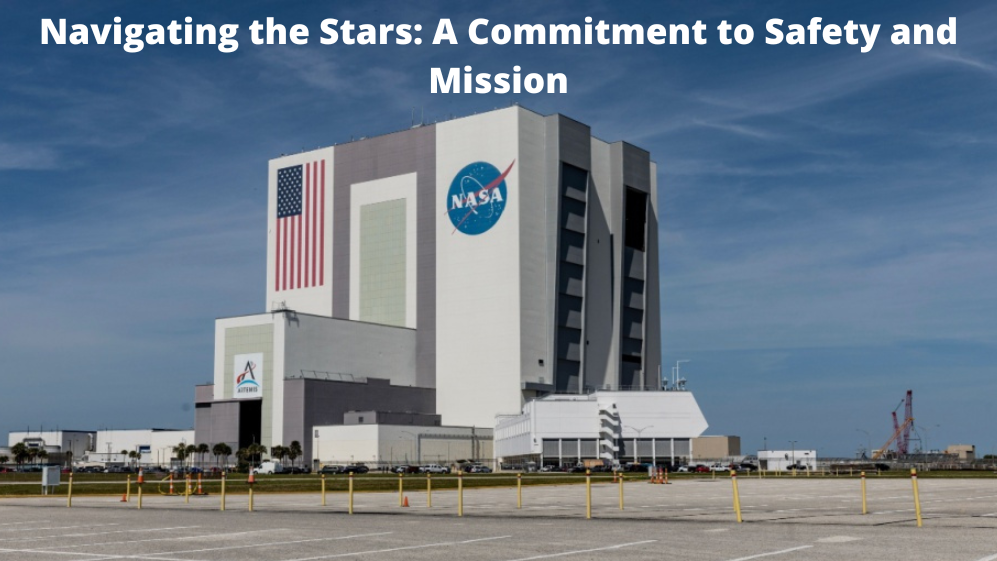
Fallston Group is a global reputational agency that often deals with the intricate balance between managing risk and maintaining trust. Recently, NASA has faced one of the most challenging decisions in its storied history: the decision to return two astronauts, Suni Williams and Butch Wilmore, from the International Space Station (ISS) using a SpaceX capsule instead of the Starliner spacecraft. This decision has sparked much discussion, and I’d like to share some thoughts on why this was not only the right call but also a testament to NASA’s evolved culture of safety, communication, and mission-driven focus. Safety: The Bedrock of Every Decision At NASA, safety isn’t just a priority—it’s the foundation upon which every decision is made. The space agency has a long history of pushing the boundaries of human exploration, but it does so with a clear and unwavering commitment to the safety of its astronauts. In the case of Suni and Butch, ensuring their safe return to Earth is non-negotiable. The decision to use a SpaceX capsule underscores this commitment, highlighting that no risk is worth taking if it could jeopardize lives. The Inherent Risks of Space Exploration Space exploration is, by its very nature, fraught with risks. Every astronaut who embarks on a mission understands and accepts these dangers. They do so because they believe deeply in NASA’s mission: to advance knowledge and make life on Earth better. Suni and Butch, like all astronauts, are driven by a sense of purpose that transcends the personal risks they face. Even in challenging circumstances, their continued presence on the ISS means more scientific work can be accomplished—work that benefits all of humanity. Learning from the Past: The Challenger and Columbia Lessons NASA’s history has not been without tragedy. The Challenger and Columbia disasters serve as stark reminders of the dangers of space exploration. What’s particularly important to remember about these incidents is that, in both cases, post-flight analysis revealed that the hardware was signaling issues long before the disasters occurred. The hardware was, in essence, “talking to us,” but the process of reviewing and acting on this data was flawed. These events taught us a crucial lesson: fostering a culture that encourages open communication and values dissenting opinions. At NASA, this lesson has been taken to heart. Today, every piece of data is scrutinized, and every voice is heard. As a leader, I’ve always believed in the importance of inviting and valuing dissenting opinions. It’s a practice that can make the difference between success and catastrophe. A Culture of Communication and Thoroughness In the current Starliner situation, NASA has demonstrated how far it has come. The agency has meticulously analyzed all available data and sought out every opinion, ensuring no stone is left unturned. This approach reflects a culture of thorough communication and an environment where every team member’s voice is valued. This culture allows NASA to make decisions based on a comprehensive understanding of the situation rather than assumptions or incomplete information. The Technical Realities and Redundancy The technical aspects of this situation are complex. The Starliner spacecraft has multiple thrusters, and while only one remains non-operational, the initial failure of five thrusters raised significant concerns. Although four thrusters were recovered in time for docking, the remaining engines’ reliability is still under scrutiny. Ground testing has provided some answers, but not enough to ensure absolute confidence in the spacecraft’s performance. In situations like this, it’s crucial to err on the side of caution. The spacecraft’s thrusters won’t return to Earth for post-flight inspection, meaning NASA can’t confirm their condition after the fact. Given this uncertainty, the decision to return the astronauts via SpaceX—a decision supported by thorough testing and analysis—was the right one. The Right Decision for the Right Reasons Starliner will return to Earth in a few days. Even if this uncrewed mission is successful, it does not negate the wisdom of the decision to prioritize astronaut safety by opting for an alternative return method. This situation is a powerful example of how NASA has evolved into an organization that embodies thoroughness, clear communication, and a culture of safety and voice for all. As someone who has spent his career helping organizations manage crises and protect their reputations, I can confidently say that NASA’s approach is a responsible leadership model. In the face of uncertainty, they made a tough but correct decision, placing the safety of their people above all else. It’s a decision that will protect lives and maintain the trust that the world places in NASA’s mission. At Fallston Group, we understand that in moments of crisis, the choices we make define us. NASA’s choice to prioritize safety and transparency is a reminder that in any field—whether exploring the stars or managing a company’s reputation—the well-being of people and the integrity of the mission must always come first.
